
Here’s another in my series on winning a pony via the medium of pony books – because every pony-mad child who doesn’t have a pony dreams of getting one. And if you couldn’t afford to buy one, then winning one in a competition might just make your dream come true.
The first competition tied to a book launch, as far as I know, was Cassell’s competition for the first of Pat Smythe’s Three Jays series in 1957. Cassell had gone all in on this one, with an extensive press campaign, and supporting materials for booksellers.
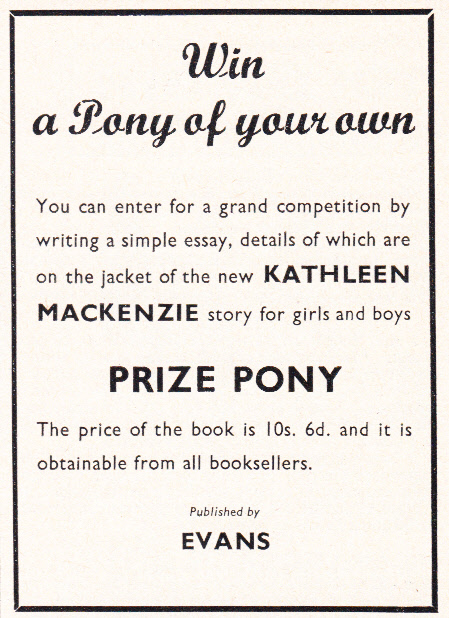
When Evans published Kathleen Mackenzie’s Prize Pony a couple of years later with a win-a-pony competition, it wasn’t with quite the same razzamatazz.

In Prize Pony (1959) our heroine Tessa lives in London. Obsessed with ponies, her father is a poor clergyman, and as if that weren’t enough of an obstacle, they live in London. Ponies are very far away, but when Tessa goes to stay in the country while her parents are abroad, she wins a pony in a raffle. Fortunately for Tessa, when her parents return, her father manages to get a living in the country and the pony can stay.
The competition
The book was launched in September 1959 and was supported by adverts in the horsy and local press. The competition itself was described on the front flap of the dustjacket:
Write down neatly in ink (on foolscap paper and in not more than 1,000 words) what you would do if you won a pony.
You then needed to send your essay off to Kathleen Mackenzie at Evans, with the coupon on the front flap.
The prizes were:
1st – A pony
2nd – Riding kit (coat, breeches cap)
3rd – Six riding lessons
25 consolation prizes

The closing date was 30 April 1960: far enough away from the original publication date I assume to allow for a reprint if sales were good enough. They were. My copy of the book is a 1959 reprint.
in the press
As well as the press campaign (which was rather low key – as far as the horsy press went, just adverts in the Christmas numbers of Pony, Riding and Horse and Hound, as far as I can see) the book was also sent out for review. This is always a nailbiting moment for a publisher. True, the Halifax Evening Courier was reasonably positive:
Winning a pony in a competition? Too far-fetched? Not at all. For the publishers are offering a pony in an essay competition in connection with the book.
Halifax Evening Courier, 4 December, 1959
But then the book collided head on with The Tatler.
Siriol Hugh-Jones, who covered children’s books, was obviously not a fan of the pony book.
All right then, we must come to horse-books sooner or later. It is simply not true to say I do not know one end of a horse from the other, as I know the head comes at the front and frequently, but not always, advances upon you ahead of the back end. I also know that horses are well equipped to run fast, some faster than others, and like those they love to blow gently up their noses. Very well then, I am doing my best.
And so she does, for at least a couple of factual books, but a brush with Barbara Woodhouse breathing up the foal’s nose in her book Wendy is too much for her (fair enough; Horse and Hound didn’t like it much either). The next book in her list is Kathleen Mackenzie’s Prize Pony.
… if you buy Prize Pony by Kathleen Mackenzie (Evans, 10s. 6d), in which Tessa the poor clergyman’s horse-mad daughter from London wins a pony at a fête, you can win one yourself by writing an essay about what you would do with it when you’d won it.
The suspense is killing me.
Passing hurriedly on from neat’s-foot oil, colic drenches, ringworm, windgalls, bog spavin and deep, understanding eternal love (not to mention nose-kissing and bitter tears at parting), we arrive at cats with Doreen Tovey’s Cats in May …
But as you might have guessed, whatever Siriol Hugh-Jones thought, pony-mad children entered that competition.
the competitors
One of them was Sue Millard, author of Against the Odds and much more. She entered the competition when she was just seven years old.
My parents bought me the book (I can’t recall if it was a birthday or Christmas gift) and allowed me to write my essay, which was required to be “What I would do if I won a pony”. They posted it for me. … What I didn’t know was that they had included a covering letter saying in effect, “If she wins FGS don’t give us the pony as we have nowhere to keep it and can’t afford livery.”
Sue was indeed a prize winner, but perhaps thankfully for family relationships, she won a consolation prize: a copy of Kathleen Mackenzie’s Red Conker.
Sue’s mother owned up much, much later when Sue had a farm, and Fell ponies, of her own.
Unusually for these competitions, I found out who came third. Eleven-year-old Sarah Goodrich of Adderbury won seven guineas’ worth of riding lessons. “If I won a pony I would be absolutely thrilled, so thrilled, that I cannot describe on paper how delighted I would be” is how she began her entry to the competition – alas, that’s all I have from ‘Uncle Tom’s’ syndicated column for children.
The winner
There was a winner. The Bookseller published a picture of ten-year-old Vicky Whimster, of Tarves, Aberdeenshire, on the pony she won. The reproduction of the picture is unfortunately so dark it’s impossible to tell very much about the pony at all – for copyright reasons I can’t include it, alas.
I hope Vicky and her pony did well and had many happy years together: at any rate more than Siriol Hugh-Jones was likely to experience in the equine field.
***
Sources, links and other things
Sue Millard: personal conversation. Sue Millard’s website
Kathleen Mackenzie, Prize Pony (1959)
The Bookseller, Saturday 16 July 1960
Chipping Norton Advertiser, Thursday 16 June 1960. This is where Sarah Goodrich’s efforts are described. In the text they have her winning second prize, but this I think is a mistake, as she wins riding lessons, which were the third prize in the book.
Halifax Evening Courier, Friday 4 December 1959
Horse and Hound, 5 December, 1959
Kensington Post, Friday 27 November 1959
Pony Magazine, December 1959
Riding Magazine, January 1960
The Tatler, Wednesday 2 December 1959
Foolscap paper is a specific size: 8.5 x 13.5 inches. I used to proofread contracts, and one piece of advice applicants were always given was to obey whatever instructions the organisation issuing the contract had. If they wanted 1,000 words, give them that. Don’t go over. If they wanted it in 50-word snippets give them that. Don’t give them an excuse to reject you. I do wonder if, when the staff at Evans opened the entries whether those written on standard bits of Basildon Bond writing paper were ruthlessly cast into the bin.
Siriol Hugh-Jones was features editor for Vogue during the 1960s. Pony books weren’t the only target for her ire: Doris Lessing, Iris Murdoch and Muriel Spark came in for it too.
Leave a Reply