
I posted recently about the Dragon Books Win a Pony competition, but this wasn’t the first Win-a-Pony competition organised by a publisher (and besides the one I’m going to tell you about, there was also one attached to Kathleen Mackenzie’s Prize Pony, published by Evans in 1959. More on that later).
Pat Smythe was an absolute phenomenon in the 1950s. She was the first woman to be in a British Showjumping Team, and the first to win an Olympic equestrian medal for Britain – team bronze at Melbourne in 1956. Her riding career coincided with the huge explosion of popularity of the pony book in the 1950s, and perhaps more importantly, television. There wasn’t much choice of channel in the early 1950s: just the one black-and-white BBC but what it did have was extensive coverage of show jumping.
the early books
Thousands upon thousands of children were swept up with the glamour and excitement of Pat Smythe and her riding career. Publisher Cassell, recognising a good prospect, signed Pat up to write about her career.
Cassell were possibly alone at this point in thinking they were going to do well. Booksellers were decidedly sniffy about the whole project. The Bookseller said that ‘most of the trade couldn’t believe, even when it happened, that a book on show jumping could sell a hundred thousand in a few months.’
But that is precisely what Jump for Joy, Pat’s account of her childhood and career so far, did in 1954. It was followed by A Book of Horses (1955) and One Jump Ahead (1956), also large sellers.


The Three Jays
Cassell recognised the absolute commercial gold that Pat Smythe represented, and commissioned her to write a children’s series. The Three Jays was going to be unique: although the Three Jays children themselves were fictional, their adventures were based in the absolutely real setting of Pat Smythe’s home and yard at Miserden, and Pat herself would be part of the stories too. (A side note – I do not know if a ghost writer was involved in any of these projects.)
Pat’s legion of fans could imagine themselves at her yard, having adventures filled with ponies and show jumping and with Pat herself.
The first book was called Jacqueline Rides for a Fall, and it was aimed at the Christmas market, being released on September 5 1957.
It wasn’t just any old release: if you bought the book, you could win a pony.
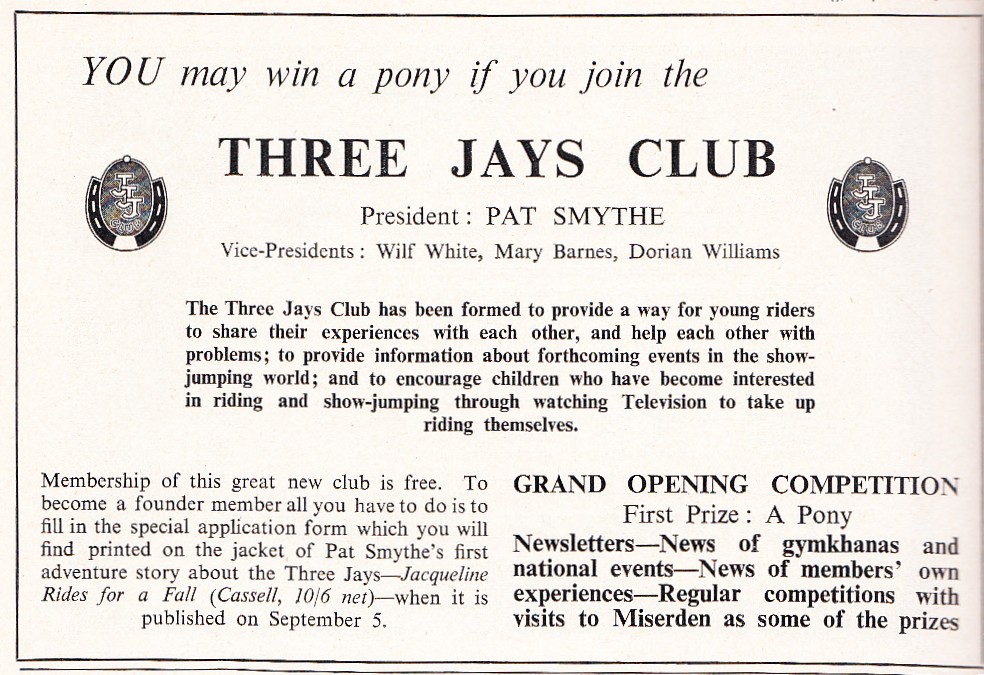
Cassell harnessed twin dreams: that of children who loved Pat Smythe and wanted to be like her, and those who wanted a pony.
They would give them both. But Cassell were very clever in the way they went about this. It wasn’t just a question of answering a few questions or telling them how much you wanted a pony. Before you could do anything, you had to join the Three Jays Club. This you could only do by using the coupon on the dustjacket of the book, thereby giving Cassell both sales and a solid-gold mailing list.
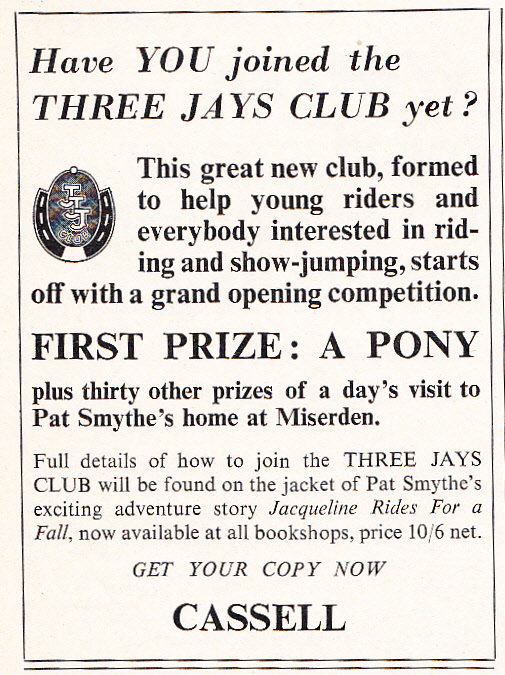
The offer was a clever one. After buying the book (or persuading someone to buy it for you) you didn’t have to pay a subscription. The club was completely free. Even if you didn’t win the pony, or get to visit Miserden, you would still get a club newsletter several times a year, plus the opportunity to enter more competitions. And every member would get a green and silver enamel badge of a horse-shoe with three Js (pictured in the advertisement above) and a yellow membership card with the rules of the club, as well as regular newsletters from Pat.
You can see the dustjacket of the first edition in the photographs below: as the coupon in the back has been neatly cut across, I assume the date to enter the competition had passed and so the coupon was clipped by the bookseller to avoid a distraught child entering and being told they’d missed the boat.


Having the club’s august president and vice-presidents as pillars of the equine establishment, as well as Pat Smythe herself, neatly sidestepped any accusation of a publisher giving a pony to just anybody. Pat Smythe was to choose the pony herself, and it would be called Pixie, after Pat’s own first pony.
how to win a pony
Once you’d joined the club, if you wanted to win the pony you had to answer the following questions:
- Why do you want to win the pony?
- Why would you like to visit Miserden?
- If you were given a pony and it was down in front, and it leaned on its bit with a fairly dead mouth, how would you go about schooling it in order to get its weight and balance in the right place?
Nancy Spain, who did a regular weekend column in the Daily Express, in which she featured Jacqueline Rides for a Fall, said: “Yes, you’re dead right. I am going to write on No. 3 But the only problem is that it is me whose mouth is fairly dead and who is down in front and who wants to get her weight back in the right place.”
To give everyone a chance, not just those who had been steeped in the way of the pony since birth, competitors only had to write an essay on one question. (I would like to know if answering 1 or 2 automatically disqualified you from winning the pony but unless I can find the answer in Cassell’s archives, I’ll just have to leave that one hanging.)
The results
The competition was a massive success.
According to The Bookseller, Sept 13, 1958, 12,000 children (and grown ups – Cassell reported their oldest member so far was 69) became members in the first year. The first three stories, Jacqueline Rides for A Fall, Three Jays Against the Clock, and Three Jays on Holiday, sold more than 82,000 copies within a year.
There were prizewinners.
Lynn Redgrave, the actress was one of the 30 lucky ones who got to visit Miserden. Pat Smythe, writing in her autobiography, Leaping Life’s Fences, said:
A happy afternoon was had when Lynn Redgrave aged fourteen won a prize in a competition run with my Three Jays series of Children’s books, when she came to a demonstration of training that I gave at Miserden for the busload of the prizewinners.
And the winner of the pony, Bridget Allen, received her prize then too although presumably the pony kept its original name of Greylag, and didn’t become Pixie.
PONY Magazine covered the great day: or at least they reprinted the account given in Smith’s Trade News. The Editor of Pony, Col CEG Hope, had been invited but was unable to go. Here’s what Smith’s said about the great day, April 15, 1958:
From the time the train left Paddington on a sunny April morning what kaleidoscopic medley of thrill and delight! The coach from Kemble being greeted round a corner by Pat Smythe on Easter Sun; the introductions to the horses – Brigadoon, Carousel, back from Switzerland and Italy, Oberon, Robin Hood and – highlight this – Tosca’s foal, Lucia; the schooling and jumping demonstrations the tour of the stable and grounds; the presentation of the pony, Greylag, to competition winner, Bridget Allen (12) of Tiverton, Devon; the film show; the showers of questions and the patient, helpful answers; until the homeward-bound coach awaited them, it was a day of unallowed [sic] delight, a memory to be treasured.
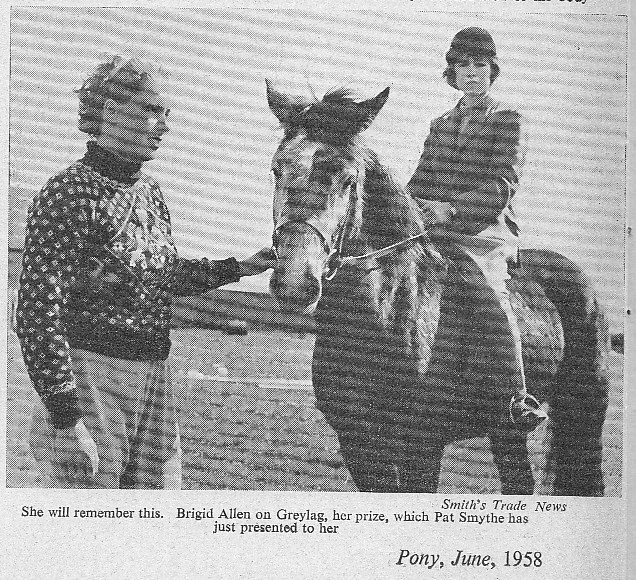
I hope it was a triumph for all involved; for Cassell and their book sales, for Pat Smythe and the ability to keep herself and her horses going, and to the lucky winner Bridget and her new pony Greylag.
Links and sources
Pat Smythe: Leaping Life’s Fences, Sporting Life, 1992
Horse and Hound, 24 August 1957
Riding Magazine, September 1957
Smith’s Trade News, as reported in Pony Magazine, June, 1958
The Daily Express, August 31, 1957
The Bookseller, 27 July 1957
The Bookseller, 13 September, 1958
The Bookseller, 7 December, 1957
Other links
Susannah Forrest has written on Pat Smythe – as well as in her excellent book, If Wishes were Horses, she has a blog post on Pat here which has some good links, including one to the relevant chapter of her book.
Leave a Reply