
Every now and then when I research something, all the planets come into alignment. Everything I want to know, I find out. It doesn’t happen often, but it is cheering when it does. I’ve recently been putting together a database of articles in Riding Magazine. I don’t usually look at the readers’ letters, but one caught my eye as I was whizzing through a 1967 copy. The correspondent was appalled at the competition Dragon Books was running where you could win a pony.
Win-a-pony competitions weren’t new – PONY magazine had run them, on and off, for years, as had many other organisations. The publishers Cassell had done one to launch Pat Smythe’s Three Jays series.
The start of Dragon Books
But back to the competition itself. Dragon Books was set up by Gordon Landsborough, who had started the immensely successful Armada Books. Dragon Books launched in 1966 with eight titles, including Mary O Hara’s My Friend Flicka, which was split into two separate volumes, with covers I think by Peter Archer.
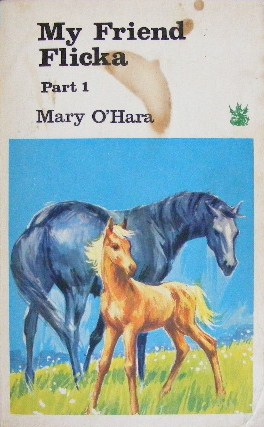

I had wondered why Dragon went with this book, and I think I have the answer: television. The commercial British channels showed re-runs of the 39-episode American show My Friend Flicka in the early 1960s, and why wouldn’t you want the book of the series you watched every week on TV?
The launch was also to be advertised on television.
Dragon didn’t stop there. When The Three Musketeers was televised in 1967, Dragon rushed through an abridged version to meet demand. They issued promotional material when Beau Geste appeared as a film.
The Bookseller, the trade paper for the bookselling trade, was extremely enthusiastic about Dragon Books’s launch. They pointed out sales of children’s paperbacks had really taken off in the past few years, and they expected 1966’s sales to top 10 million. The market is as big as we care to make it, they said.
How to encourage readers
Dragon’s launch had been designed “to extend dramatically readership of children’s paperbacks.”
The competition itself appeared in magazines – you can see below a full-page example in Pony Magazine. Children could complete the first stage of the competition, which involved matching eight characteristics with eight fictional characters, on the coupon in the advert. But to enter, you needed the coupon you could only get if you actually bought a book. As far as I can see, you didn’t have to buy My Friend Flicka. If you bought one of the other books, they’d have the coupon too.
You can only imagine the pestering that went on: after all, the child had already done the first bit of the competition, and all that needed to happen now was for someone to buy a book.

As the Bookseller said, it was the snowball effect.
An imaginative competition will be advertised on television and in children’s periodicals, with thousands of attractive prizes. But the essential part of this competition is that entrants must introduce the competition to their friends, who can also enter it by introducing other friends. A snowball – and heaven knows how big it can become.
The Bookseller was doing its bit, and it encouraged booksellers everywhere to co-operate by doing a “bold display” of Dragon Books and handing out the competition to every child who crossed their threshold, whether they bought a book or not. (The Bookseller, July 30, 1966)
As Dragon printed half a million leaflets, public awareness must have been pretty wide. Was the campaign a success?
Dragon sold a million books before Christmas. Those children the competition was aimed at had indeed been busy recommending the competition to their friends.
The downside
Although The Bookseller didn’t mention it, the top prize was a pony, and that was a problem.
Here’s an extract from a letter in Riding Magazine in January 1967 (Riding was put together some months in advance hence the date discrepancy).
I have recently received a leaflet, issued by a reputable enough firm, offering a “three-year-old colt” (the italics are mine) as a first prize in a competition. No conditions are attached and no provision is made for the keep of the animal… Competitions of the kind mentioned expose the animal concerned to the risks of neglect and abuse and to stage them is to act irresponsibly. I can only hope that the ignorance displayed by this firm extends to the description of the animal and that it is, in fact, not a colt but a gelding.
Riding Magazine were disturbed enough by all this to get in touch with the publishers, and this is what they said in reply to their correspondent:
We approached the Managing Director of the Atlantic Book Publishing Co Ltd, Mr Gordon Landsborough, whose subsidiary, Dragon Books, organised this competition, to obtain his comments.
In a very frank letter he assures us that ponies will not in future be offered as prizes in any competitions run by this organisation. He also tells us that he has accepted – gladly – the services of the RSPCA and the pony will only be placed if that body is satisfied that it is going to a home where it will be properly cared for.
The pony is, in fact, a filly, and the word colt, to describe any young horses, is an American term used consistently in the book My Friend Flicka.
You can only imagine the horror in the sales department when it all kicked off.
The winners
So what happened? Did the filly find a new home through the competition?
The Bookseller’s edition on January 7, 1967 had the important details. Although the competition closing date was December 12, Dragon had managed to get all 2,500 prizes to the lucky winners by Christmas. The winner of the competition was Barbara, from Thirsk. Barbara didn’t get a pony for Christmas. She took £125 in lieu of the pony, as she was not able to keep one.
I wonder if Barbara had entered the competition hoping desperately that she would be able to have the pony, and I can only imagine her despair if that’s what she’d wanted, and it didn’t work out.
I do not know what happened to the filly: presumably she was quietly sold on.
What happened next
Dragon must have been very tempted to repeat their competition. After all, there had been, as the Bookseller said, an outstanding response to it.
After doing some research into reading habits, Dragon decided to run five monthly competitions in 1967, with the competitions publicised at the back of Dragon’s Spring list titles. The prizes? Transistor radios and cameras for the most interesting letters children sent in about their reading.
links and sources
Riding Magazine, January 1967
The Bookseller, 2 April, 1966
The Bookseller, 30 July, 1966
The Bookseller, 7 January, 1967
Gordon Landsborough on Wikipedia
Other interesting things
Gordon Landsborough, the founder of Dragon, was a writer himself. He wrote over 90 books, many under pseudonyms. He abridged books too, and the Dragon abridgement of Beau Geste was his work.
Michael Geare, who was employed by him in 1957 as sales manager (at Four Square I think), said of him:
He was a gifted, clever, likeable chap, and really knew everything about book publishing. On one occasion when we were a book short on the list, he took five days off and wrote the book himself – ‘Return Via Benghazi’ or something. It wasn’t half a bad paperback, either.
From National Life Stories: Book Trade Lives, The British Library sound archives (oral history); published as The British Book Trade: an Oral History, British Library Publications, October 2008
Dragon Books’s first eight titles were: My Friend Flicka Part 1, My Friend Flicka Part 2 (Mary O’Hara), Mystery of the Burnt Cottage and Mystery of the Disappearing Cat, The Red Story Book, The Blue Story Book (all Enid Blyton), Beau Geste (P C Wren) and R M Ballantyne’s The Coral Island.
More on winning-a-pony competitions:
Pat Smythe, Cassell and the Three Jays Club
PONY Magazine and how not to run a Win-a-Pony Competition (by Janet Rising)
Leave a Reply