
About the author
Allen W. Seaby (1867–1953) was born in London in 1867, and began studying evening classes at the Reading School of Art. He was appointed a lecturer in art at the school, which became part of the University of Reading. He became professor of art there from 1920–33.
He was one of the last exponents of the pony stories in which the pony was the hero. He concentrated on British native breeds, meaning that his books still have a popularity today, with the resurgence in popularity of native breeds. The stories reflect the changing times in which they were written: the coming of the car and its dominance; war, and the cheapening in value of ponies. Perhaps they also reflect a changing in sentiment: the original dustjacket of Skewbald was objected to because it showed a picture of two ponies fighting. This was seen as a bad example to children, so Allen Seaby had to ‘draw another illustration less inciting to evil.’ [Source: Dinah the Dartmoor].
Seaby and his family spent much time in the New Forest, where his first book Skewbald the New Forest Pony, was set. After several camping expeditions, the family bought a plot of land at Wootton, where they built a wooden hut in which they spent many holidays.
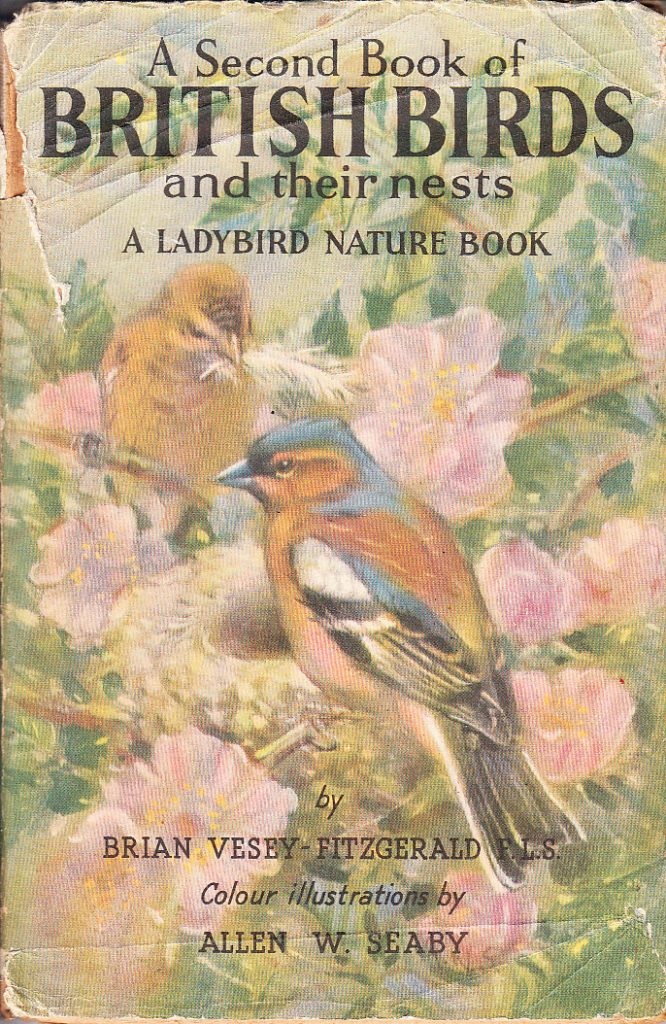
Ponies were by no means the only thing Seaby painted. If you’re keen on Ladybird books, you might well know Seaby’s illustrations from the British Birds and their Nests series, which he illustrated.
Finding the books
Skewbald and Exmoor Lass, having been reprinted many times, are both easy to find, and cheap. British Ponies and Our Ponies are reasonably easy to find, but can be expensive. Dinah and Sons of Skewbald are reasonably easy to find, though not with their dustjackets. Mona and Sheltie are the hardest titles to find, and because of the native pony connection, tend to be sought after and expensive.
Links and sources
Dinah the Dartmoor, 1935, foreword
St Barbe Museum and Art Gallery has extensive information on Seaby and his time in the New Forest
Amara Thornton, Ure Museum, on Allen Seaby
Allen Seaby at the University of Reading (includes a link for one of his unpublished works)
Allen Seaby, National Galleries of Scotland
Many thanks to Dawn Harrison for her help with the photographs.

Bibliography
Skewbald the New Forest Pony
A & C Black, 1923. Reprinted often:
1927, 1929, 1934, 1936, 1940 (twice),1945, 1946, 1949, 1962, 1964
Skewbald is a New Forest pony, and this is the story of him and his herd, and of the life of the New Forest. It isn’t a story with a happy ending, as an attempt to rope Skewbald goes very badly wrong.


Exmoor Lass and Other Pony Stories
A & C Black, 1928
Reprinted many times
Short stories about an Exmoor pony, a herd of Shetlands being rounded up, a ride in the New Forest, a rescue from a Dartmoor bog, a Welsh ride and a girl living in ancient Cornwall.

Omrig and Nerla: A Tale of the Bronze Age
Harrap, London, 1934, 221 pp, illus the author
A story of horses and ponies in the Bronze Age.
Dinah the Dartmoor Pony
A & C Black, 1935
A& C Black, 1957, 184 pp
Dinah was born wild on Dartmoor, but after she injured a foot, could not keep up with her mother in a round up and was separated from her, being left to survive alone. She wanders near to a farm, and Dolly, the daughter of the farm, takes pity on Dinah and feeds her. The two are eventually separated, but when Dolly is married with a daughter of her own, they are reunited.


British Ponies, Running Wild and Ridden
A & C Black, 1936
This is non fiction, but I’ve included it because it is a very beautiful book, profusely illustrated. If you can find it, it’s well worth getting.

Sons of Skewbald, or Castor and Pollux
A & C Black, 1937
Before he died, Skewbald fathered several foals. One mare had twins, Castor and Pollux. Their lives reflect the changes coming upon the Forest: the fall in the ponies ‘value now they are no longer used for the mines; the increasing danger of traffic. Sally, their owner, sells them at the Pony Sale to E F Ranger, a circus man, who wants her to keep them for him for a couple of years until he is ready for them.

Sheltie, the Story of a Shetland Pony
A & C Black, London, 1939, 212 pp.
This is the story of a Shetland pony, from his first days on his native hillside above Baltasund, and then down to southern England, in a circus, at a pony show, and finally as the trusted mount of a child.
Many thanks to Cherie Goninon for the picture.

Mona, the Welsh Pony
A & C Black, London, 1948, illus the author, 144 pp.
“In this new book [Seaby[ turns to the mountain ponies of North Wales, and tells the enthralling story of Mona against the background of his native landscape, its people and their history.” Mona is born on the Welsh hills, and Evan Evans decides he will catch her. She soon fits into life on the farm, and her training begins. Be warned – this does involve riding a yearling. Evan Evans goes off to war, and Mona eventually goes to be a sands pony.

Our Ponies
Penguin Books, 1959 (Picture Puffin)
Non fiction, this is a lovely survey of British native ponies. It’s a source of much grief to me that I can’t find my copy anywhere (and that wasn’t even the original, which I also lost – this is a replacement my mother-in-law bought me …)

Short stories and excerpts
Excerpts from his books are contained in:
Twenty More Animal Stories
Blackie & Son, 1941
New Forest Ponies: Their lives and habits
Ponies in a Window: a New Forest Story
